RESEARCH
My research combines atmospheric physics and environmental modelling to understand and represent processes linking radiation, the atmosphere, terrestrial and aquatic systems, and the carbon cycle. Current work ranges from spectral radiation and the Lozano Closure to soil-carbon modelling, satellite–ground evaluation, and reconstruction of surface radiative conditions.
Across these areas, a common objective is to develop representations that retain physical meaning while remaining transferable across observations, sites and environmental systems. My work combines ground measurements, satellite observations, statistical and data-driven methods, and process-based modelling.
Explore current work and developing directions, or browse selected research outputs and my broader research trajectory:
Current Research
The Lozano Closure and spectral radiation
Development and evaluation of a physically constrained framework linking broadband solar radiation with spectral sub-bands. Current work extends beyond the first PAR implementation toward the physical behaviour of spectral mapping coefficients, alternative closure solutions, other spectral intervals, diffuse partitioning, and applications of the LC to existing atmospheric-radiation methodologies.
Current status:
- PAR manuscript under review
- Broader framework under active development
Soil carbon modelling and heterotrophic respiration
Evaluation and development of soil-carbon representations using ORCHIMIC, with current work examining whether separating humus and mineral soil layers provides a more physically realistic and accurate representation of heterotrophic respiration than a vertically aggregated soil formulation. The calibrated framework is also providing a basis for subsequent coupling with vegetation modelling and climate-driven applications.
Current status:
- Model calibration completed
- Manuscript in preparation
Satellite–ground evaluation of environmental observations
Evaluation of satellite-derived environmental products against ground-based observing networks, beginning with surface radiation across Finland using multi-site ground observations. Planned work extends this framework toward ecosystem carbon products and methods for transferring information from eddy-covariance observations to regions where tower measurements are unavailable.
Current status:
- Finland surface-radiation validation manuscript ready
- Extension toward ecosystem carbon products under development
Surface radiation reconstruction from satellite observations
Development and evaluation of approaches for reconstructing surface radiative conditions from satellite information, including longwave and shortwave radiation and validation against ground measurements. Initial work focuses on Finland and the Nordic region, with the longer-term objective of producing spatially consistent representations where dense surface observations are unavailable.
Current status:
- Longwave and shortwave reconstruction framework under development
- Initial focus on Finland and the Nordic Region
Developing research directions
Beyond the research lines currently being executed, several developing directions extend the broader scientific programme toward new applications, spectral domains, and coupled atmosphere–ecosystem questions. These directions are actively being formulated and tested, although they are not all associated with funded projects at present.
- Lozano Closure extensions and spectral generalisation
- Physically based radiation methodologies
- Atmosphere-ecosystem coupling
- Satellite-enabled ecosystem and radiation modelling
- Climate and decision-oriented environmental modelling
Lozano Closure extensions and spectral generalisation
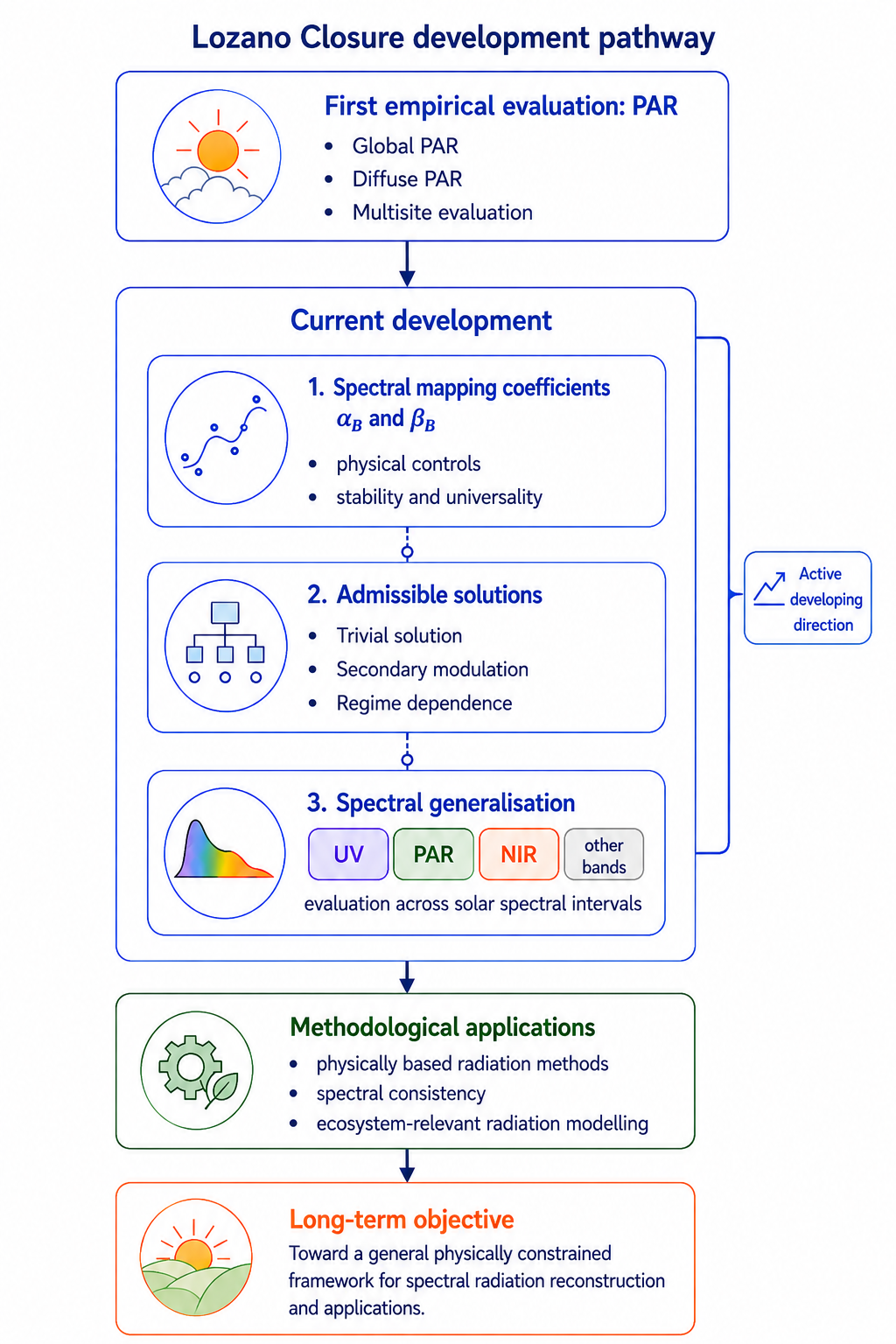
The first empirical evaluation of the Lozano Closure has so far been carried out for photosynthetically active radiation (PAR), showing that broadband shortwave transmissivity contains sufficient physical structure to reconstruct both global and diffuse PAR across multiple sites without site-specific calibration. This first demonstration provides the basis for a broader research line aimed at extending the closure beyond its initial PAR formulation.
Current development focuses on the behaviour and interpretation of the spectral mapping coefficients and , including their stability, admissible forms, and possible dependence on spectral interval and atmospheric regime. A central objective is to determine under which conditions simple closure solutions remain valid, and when secondary modulation or more general formulations are required.
A second line of development concerns spectral generalisation. The broader framework is being extended toward additional solar spectral bands beyond PAR, with the aim of testing whether the same top-of-atmosphere-normalised closure logic can provide physically consistent mappings for other intervals of the solar spectrum.
A third direction is methodological application. The Lozano Closure is also being explored as a basis for improving existing atmosphere–radiation methods, including physically constrained reformulations of empirical relationships and more coherent links between broadband observations, spectral radiation, and ecosystem-relevant radiative quantities.
Physically based radiation methodologies
A substantial part of my research concerns the development and refinement of methods used to characterise atmospheric radiation. Many widely used approaches provide useful estimates but rely on empirical assumptions, locally calibrated relationships, or simplified representations whose physical meaning and transferability are not always clear.
This research direction aims to reformulate and extend such methods using physically constrained quantities such as atmospheric transmissivity, solar geometry, and the relationships between broadband and spectral radiation. Particular attention is given to identifying which parts of existing methodologies reflect general radiative behaviour and which arise from site-specific or empirical assumptions.
Developing directions include improved clear-sky identification, physically based interpretation and reformulation of maximum-transmissivity approaches such as , and methods that connect broadband, spectral, and diffuse radiation more consistently. The broader objective is to obtain radiation methodologies that remain simple enough for observational applications while retaining a defensible physical basis and improved transferability across sites and atmospheric conditions.
Atmosphere–ecosystem coupling
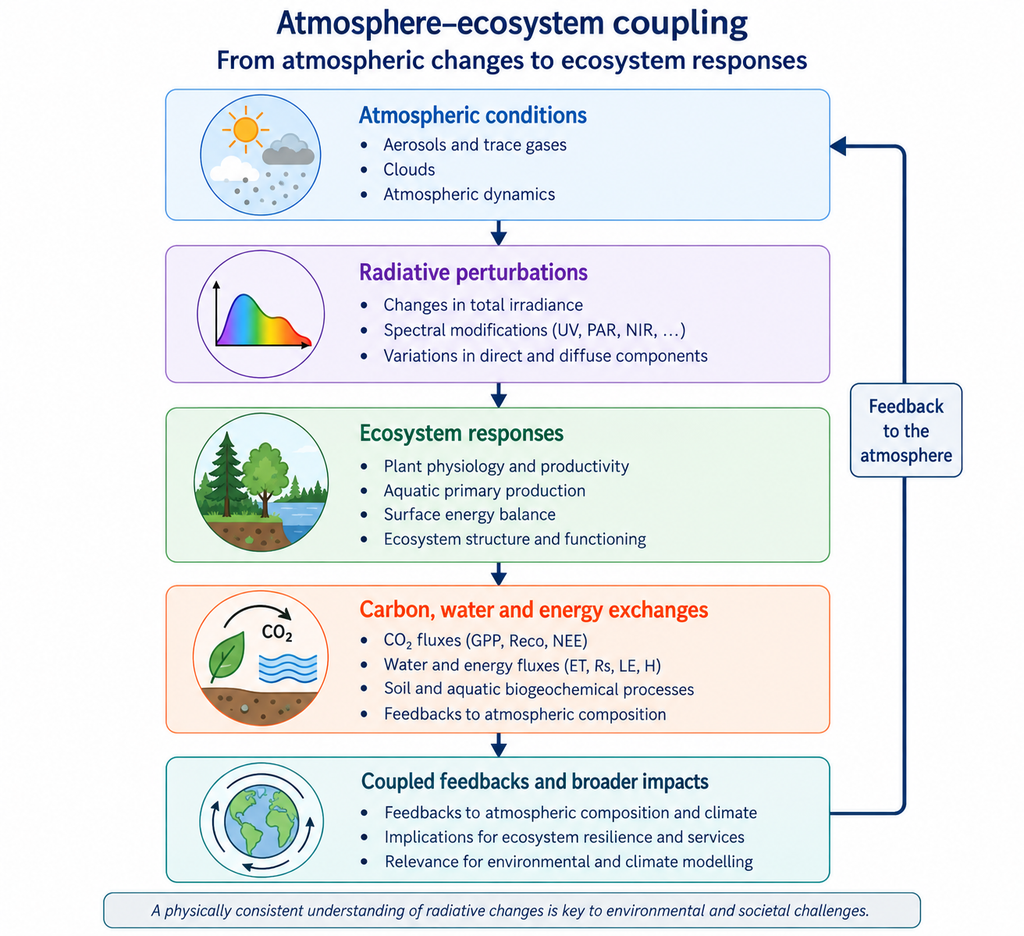
Changes in atmospheric composition and cloud conditions modify not only the amount of solar energy reaching the surface, but also its spectral distribution and partitioning between direct and diffuse radiation. These changes can propagate into biological systems, influencing vegetation, aquatic environments, surface energy exchange, and ecosystem functioning.
This developing research direction investigates how atmospheric radiative perturbations translate into ecosystem responses and how those responses interact with carbon, water, and energy exchanges. A central interest is to move beyond treating atmospheric and ecosystem processes as separate problems and instead investigate the physical pathways through which changes in the radiative environment influence biological systems.
The longer-term objective is to identify when these responses become relevant for atmosphere–ecosystem feedbacks and how physically consistent radiation information can improve their representation in environmental and Earth-system modelling. The Lozano Closure provides one possible bridge within this programme by allowing spectral and diffuse radiative information to be related consistently to broadband observations.
Satellite-enabled ecosystem and radiation modelling
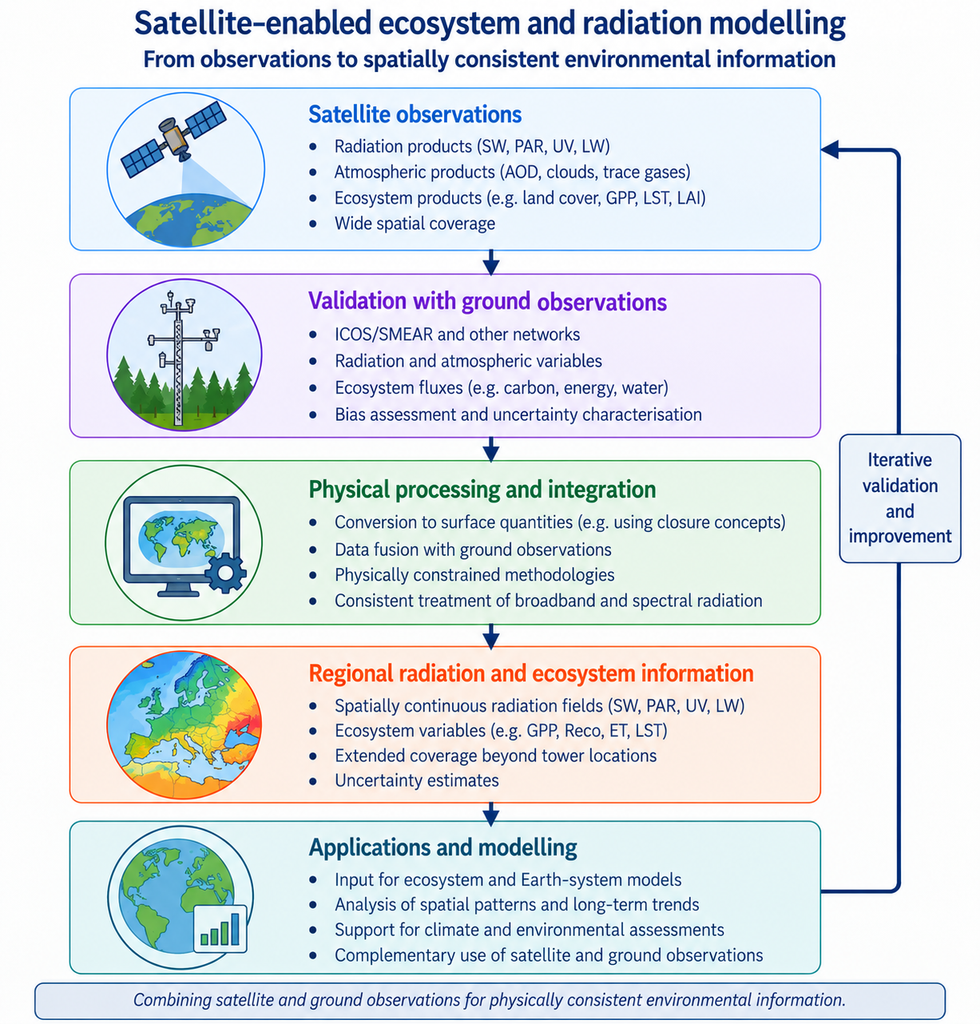
Satellite observations provide the spatial coverage needed to investigate environmental processes beyond the relatively small number of locations equipped with high-quality ground-based measurements. Their broader use, however, requires careful evaluation against surface observations and methods capable of translating satellite-derived information into physically meaningful environmental quantities.
This research direction builds on satellite–ground validation work to explore how remotely sensed radiation and ecosystem products can be combined with ground observations and environmental models. One objective is to reconstruct surface radiative conditions across regions where dense radiation measurements are unavailable, using validated satellite products as spatially continuous information.
A complementary direction concerns ecosystem carbon exchange. Satellite-derived ecosystem products may provide a basis for extending information obtained from eddy-covariance networks beyond individual tower locations. This includes investigating whether relationships derived from ground-based ecosystem respiration can be used to estimate components such as heterotrophic respiration in regions where direct tower observations are unavailable.
The long-term aim is not simply to replace ground measurements with satellite data, but to combine the complementary strengths of both observing systems with physically interpretable modelling.
Climate and decision-oriented environmental modelling
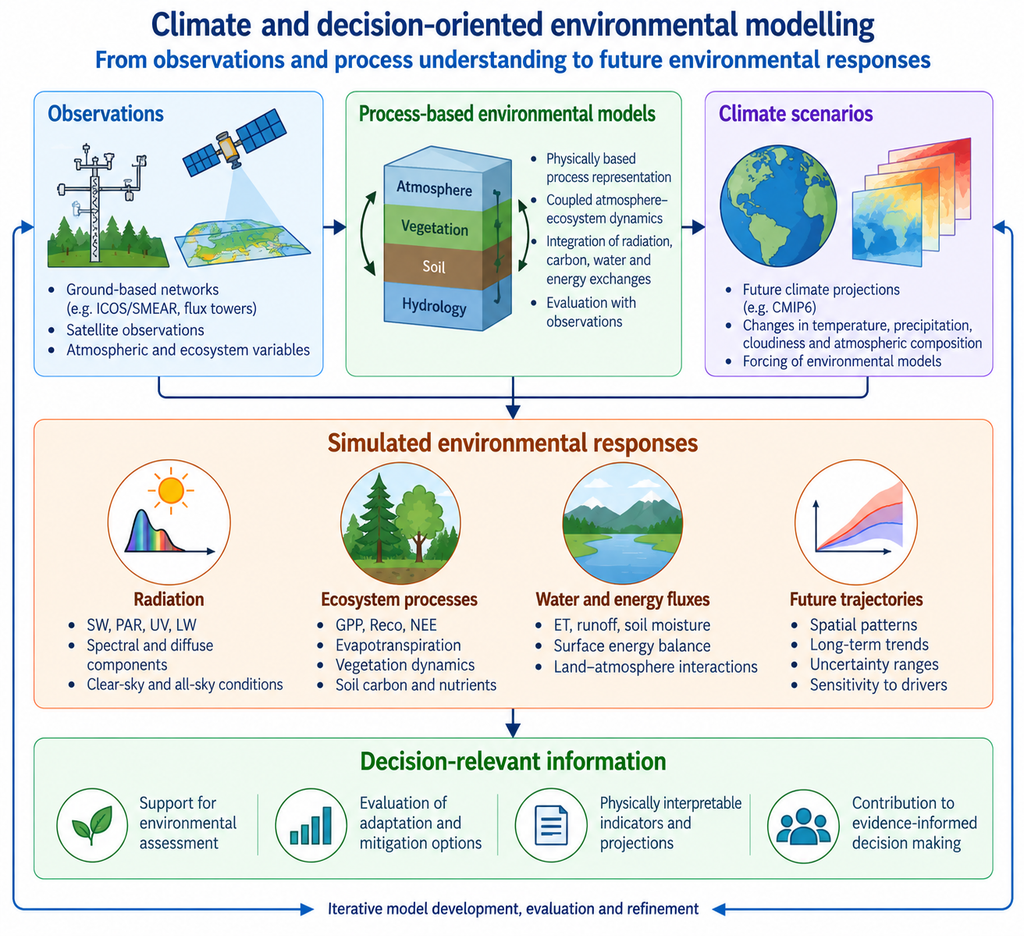
Environmental models become particularly valuable when they can move beyond reproducing present conditions and be used to investigate how environmental systems may respond to future change. Achieving this requires models whose internal representations remain physically interpretable when they are applied outside the conditions under which they were calibrated.
This developing direction aims to combine improved process representation with climate-driven simulations to explore future trajectories of environmental systems. In the soil-carbon context, for example, the development of more physically explicit ORCHIMIC configurations provides a basis for subsequent integration with vegetation modelling and the incorporation of future climate scenarios.
The broader objective is to develop modelling frameworks that can be used both for scientific exploration and, where sufficiently validated, for evaluating possible future environmental responses relevant to management and decision-making. Rather than treating scenario modelling as prediction alone, the emphasis is on understanding the mechanisms responsible for modelled changes and the conditions under which those responses remain credible.