The Lozano Closure: A physically constrained spectral mapping between broadband solar radiation and spectral sub-bands
The Lozano Closure (LC) is a top-of-atmosphere-normalised framework that links broadband shortwave transmissivity with the transmissivity of spectral sub-bands. Rather than treating spectral irradiance reconstruction as an empirical regression problem, the LC derives the mapping from the shared physical structure of atmospheric attenuation.
The framework has so far been empirically evaluated for photosynthetically active radiation (PAR), reconstructing both global and diffuse PAR from broadband shortwave radiation without site-specific calibration or auxiliary meteorological predictors. The broader framework provides a basis for investigating spectrally consistent reconstruction across other solar spectral sub-bands.
Why a spectral closure?
Solar radiation across different spectral bands is governed by the same atmosphere, but not with the same spectral weighting. The Lozano Closure starts from this shared physical structure and asks whether broadband atmospheric transmission can provide a physically constrained coordinate for reconstructing the transmission of individual spectral sub-bands.
Same atmosphere, different spectral response
Molecular absorption, scattering by molecules and aerosols, and cloud extinction act across the solar spectrum. Their relative contributions, however, vary with wavelength, so the effective attenuation of a spectral band does not necessarily mirror that of broadband shortwave radiation.
A common transmissivity space
Normalising surface irradiance by its top-of-atmosphere counterpart produces a dimensionless measure of atmospheric transmission. Broadband shortwave transmissivity integrates the combined influence of atmospheric attenuation and redistribution, providing a compact description of the radiative state through which spectral sub-bands also propagate.
A constrained mapping rather than an arbitrary fit.
The LC asks whether the effective attenuation of a spectral sub-band can be related systematically to broadband attenuation through their underlying optical-depth structure. The objective is not simply to reproduce observations, but to derive a mapping that remains bounded, interpretable, and consistent with the multiplicative nature of atmospheric transmission.
Can the spectral response of the atmosphere be reconstructed from broadband transmission without treating each spectral band as an independent empirical problem?
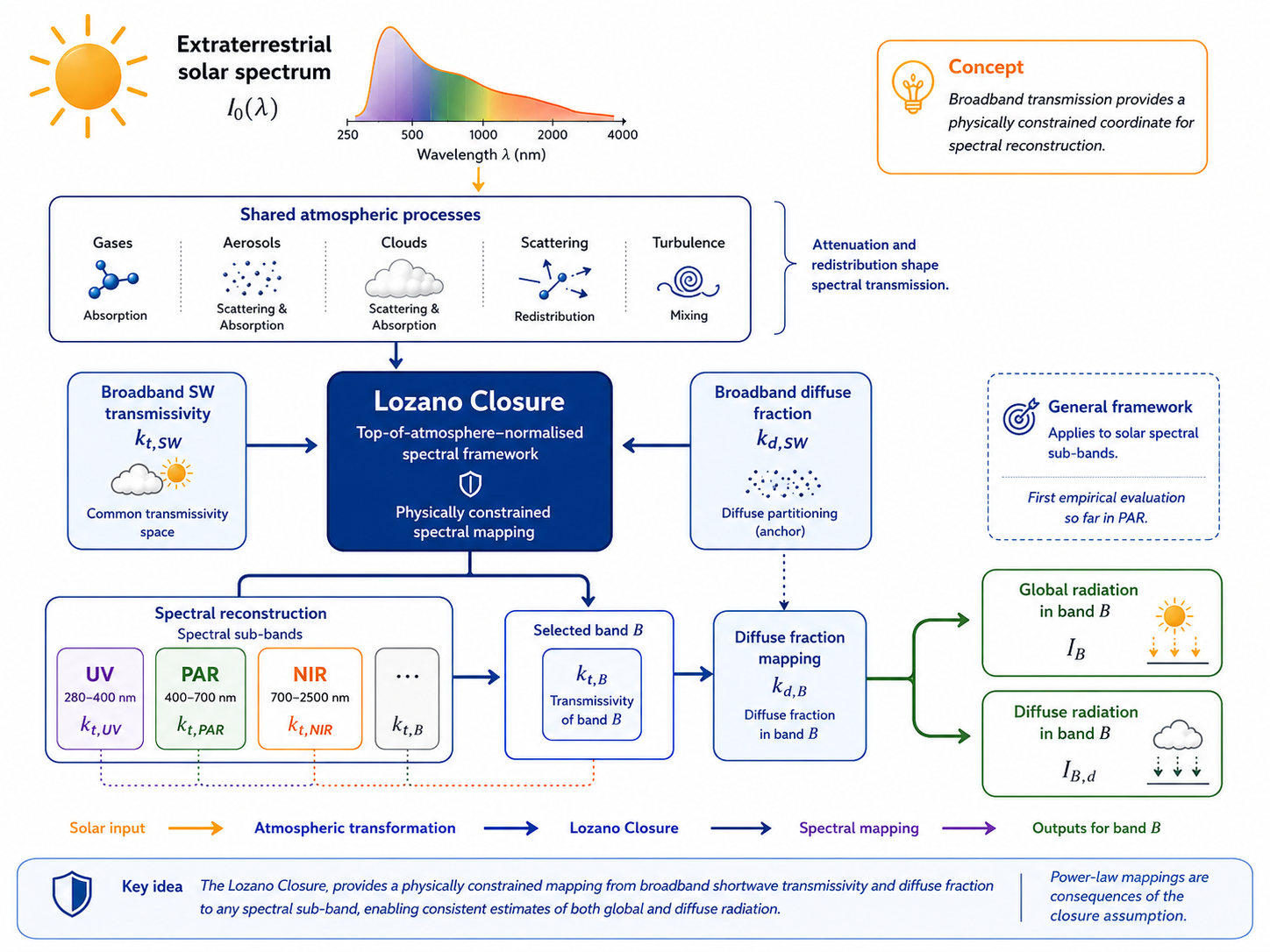
Conceptual overview of the Lozano Closure framework.
The framework links broadband shortwave transmissivity and diffuse fraction to spectrally consistent reconstruction of solar sub-bands and their diffuse components.
The physical basis
where
denotes any selected solar spectral band
where I0,B is the top-of-atmosphere irradiance integrated over band B.
The Lozano Closure is formulated in transmissivity space. For any solar spectral band B, surface irradiance can be represented as the extraterrestrial irradiance in that band modified by the integrated effects of atmospheric attenuation and redistribution. Normalising by the corresponding top-of-atmosphere irradiance provides an effective band transmissivity that can be related to broadband shortwave transmissivity through their optical-depth structure.
;
The closure assumption:
Broadband shortwave radiation and the selected spectral band are affected by the same atmospheric extinction processes, but with different spectral weighting. This proportionality is the central closure assumption. The dimensionless coefficient represents the relative effective attenuation of band B with respect to broadband shortwave radiation.
The resulting spectral mapping
Substituting the closure assumption into the effective transmissivity representation yields a direct mapping between broadband shortwave transmissivity and the transmissivity of the selected spectral band:
The exponent αB therefore acts as a dimensionless spectral mapping coefficient, relating the effective attenuation of band B to that of the broader shortwave spectrum. The mapping preserves the multiplicative structure of atmospheric transmission while accounting for systematic differences in spectral weighting.
The power-law mapping is a consequence of the closure assumption; it is not, by itself, the definition of the Lozano Closure.
Diffuse partitioning
Total transmissivity describes how much radiation reaches the surface, but not how that radiation is partitioned between direct and diffuse components. Extending the LC to diffuse radiation therefore requires an additional mapping between the broadband and spectral-band diffuse fractions.
Here, βB is a dimensionless diffuse-partition mapping coefficient. In contrast to the total-transmissivity mapping, diffuse partitioning is particularly sensitive to scattering, angular redistribution, cloud properties, aerosols and surface–atmosphere interactions.
Here, B denotes any selected solar spectral sub-band. The LC provides the general physical mapping, while the behaviour, stability and transferability of αB and βB must be established for each spectral interval and atmospheric regime.
First empirical demonstration: PAR
The Lozano Closure has so far been empirically evaluated for photosynthetically active radiation, including both global and diffuse PAR, across multiple measurement sites and contrasting climatic regimes.
What has been demonstrated
The multisite evaluation shows that broadband shortwave transmissivity contains sufficient structure to reconstruct global PAR with high cross-site consistency, while the additional diffuse-partition mapping substantially improves the representation of diffuse PAR. The evaluation was performed without site-specific calibration or auxiliary meteorological predictors.
What the demonstration establishes
The PAR evaluation provides the first empirical test of the LC hierarchy, from the coefficient-free trivial solution to non-trivial spectral and diffuse-partition mappings. It supports the physical interpretation of the framework while also revealing residual structure that motivates further development of αB, βB, and their dependence on spectral and atmospheric regimes.
An active and developing framework
Spectral mapping coefficients and
Understanding their physical controls, stability, universality, spectral dependence, and possible regime-dependent modulation.
Extension across spectral bands
Testing the applicability and transferability of the closure beyond PAR and establishing its behaviour for other solar spectral intervals.
Admissible solutions and secondary modulation
Developing the hierarchy of closure solutions while preserving physical interpretability, structural simplicity, and cross-site transferability.
Applications of the LC
Applying the framework to radiative methods, spectral consistency, atmosphere–radiation analyses, and ecosystem-relevant radiation modelling.
These developments form part of the wider Photonsphere research initiative, where the LC connects with atmosphere–radiation interactions, atmosphere–ecosystem feedbacks, and carbon-cycle research.