Photonsphere is a developing research initiative connecting atmospheric radiation, environmental processes, and ecosystem responses through physically interpretable and transferable approaches.
It brings together research ranging from the physical representation of solar radiation and its interactions with atmospheric components to ecosystem responses, feedback mechanisms, and carbon-cycle processes. Rather than defining a single project, Photonsphere provides a scientific framework through which these research directions can develop and interact.
Why Photonsphere?
Atmospheric radiation is altered by gases, aerosols and clouds; these changes affect the spectral and diffuse distribution of energy reaching the surface; ecosystems and organisms respond; and those responses propagate through carbon, water and energy exchanges, ultimately contributing to atmosphere–ecosystem feedbacks.
A shared physical pathway
Solar radiation, atmospheric composition and ecosystem functioning are often studied as separate domains, despite being connected through the same transfer of energy through the Earth system. Photonsphere treats these connections as part of a common physical pathway rather than as isolated research problems.
From mechanisms to feedbacks
Solar radiation, atmospheric composition and ecosystem functioning are connected across scales. Understanding these links requires moving from atmospheric attenuation and spectral redistribution to biological responses, carbon and water exchanges, and ultimately feedbacks between the atmosphere and ecosystems. Photonsphere provides a framework for studying this continuity while retaining the physical meaning of each process.
Research Programme
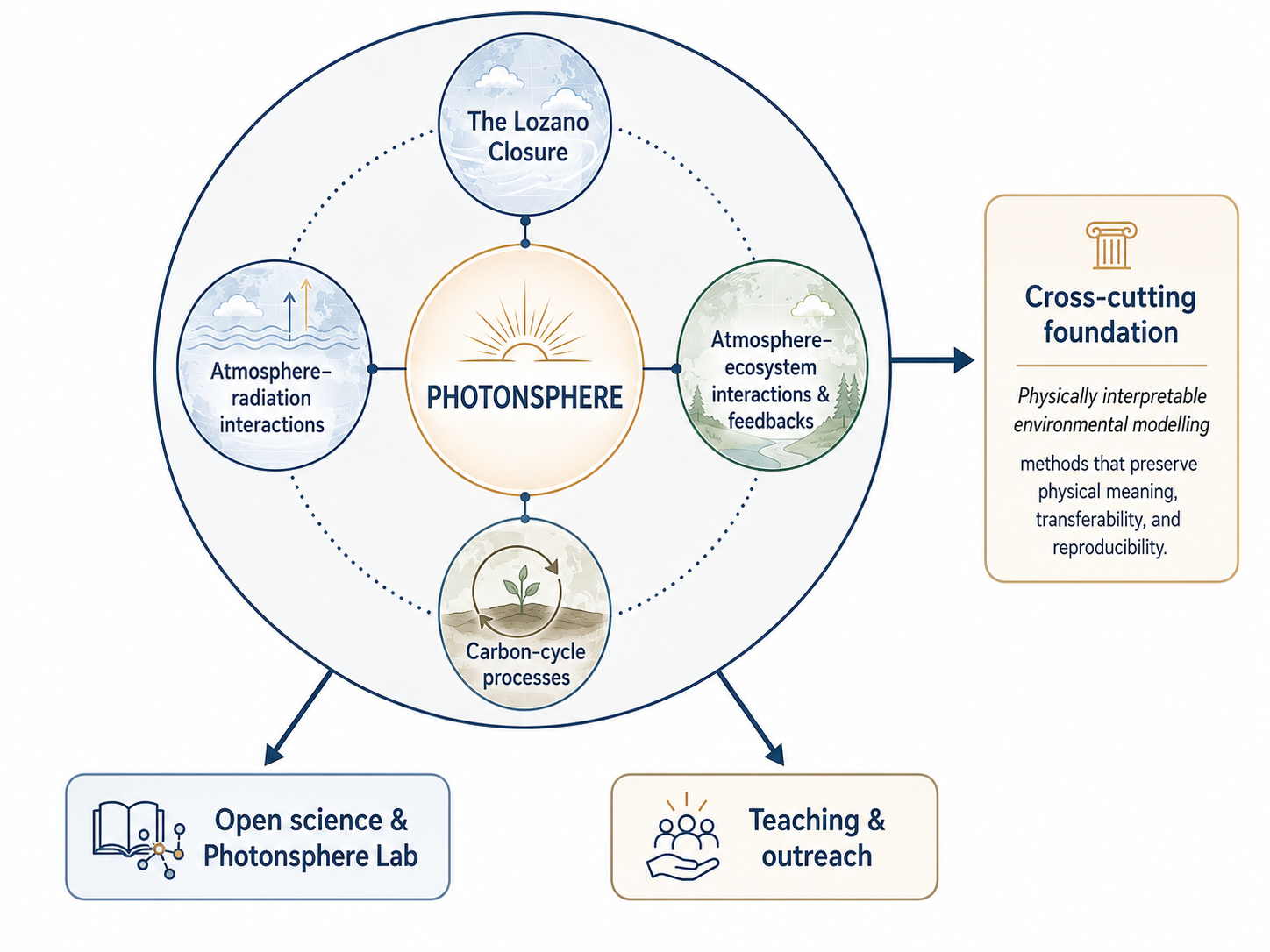
Photonsphere is organised around four interconnected scientific domains, supported by a common methodological foundation centred on physical interpretability, transferability, and reproducibility.
The Lozano Closure
Spectral closure theory, development and evaluation: Development of physically constrained relationships between broadband solar radiation and spectral sub-bands, including the theoretical structure of the Lozano Closure, its admissible solutions, the behaviour of spectral mapping coefficients, and evaluation across spectral bands and atmospheric regimes.
Atmosphere–radiation interactions
How atmospheric composition and structure modify solar radiation: Investigation of how aerosols, clouds, gases and atmospheric conditions control attenuation, scattering, absorption, spectral redistribution and radiative partitioning, together with the development of physically based methods for their observation and analysis.
Atmosphere–ecosystem interactions and feedbacks
From radiative perturbations to ecosystem responses: Study of how changes in radiation, spectral composition and diffuse partitioning propagate into vegetation, soils, aquatic systems and other biological components, and how these responses contribute to coupled atmosphere–ecosystem feedbacks through energy, water and biogeochemical processes.
Carbon-cycle processes
Carbon exchange, metabolism and storage across environmental systems: Investigation and modelling of carbon exchange and storage across terrestrial and aquatic systems, including ecosystem productivity, respiration, soil and forest carbon dynamics, and metabolic responses to environmental change.
Physically interpretable environmental modelling
Methods that preserve physical meaning and transferability: Development and application of observational, statistical, process-based and data-driven approaches that retain interpretable links to the environmental processes being represented, with particular emphasis on transferability, methodological validation and reproducibility.
Cross-cutting layers
Open science & Photonsphere Lab
Photonsphere extends beyond individual studies through open scientific software, reproducible workflows, quality-control procedures, and reusable computational tools. Photonsphere Lab provides the practical and computational layer through which these methods can be shared, tested, and developed openly.
Teaching & outreach
The programme also includes a communication and educational dimension aimed at connecting scientific understanding with students, researchers, and wider audiences. Teaching materials, explanatory resources, and public-facing activities provide complementary ways of sharing the concepts, methods, and broader relevance of the research.
A developing programme
Photonsphere is currently a developing research initiative and the foundation of an emerging research group. Its structure is intended to evolve as new research, collaborations, datasets, methods and open scientific tools become part of the programme.