PUBLICATIONS & TALKS
My scientific outputs span atmospheric radiation, aerosols and clouds, environmental and ecosystem research, and physically interpretable modelling. This page brings together peer-reviewed publications, manuscripts in development, conference contributions, and selected presentations, linking them where possible to the research questions and projects from which they emerged.
Explore selected outputs, current manuscripts, publications, and conference contributions:
Under review
The Lozano Closure: A TOA-Normalised Spectral Mapping Between Broadband Shortwave Radiation and PAR
Current status: Under review. Discussion started: 08 Sep 2026
Authors: Ismael L. Lozano, Ekaterina Ezhova, Inmaculada Foyo-Moreno, Inmaculada Alados, and Markku Kulmala
Short scientific description: This manuscript presents the first empirical evaluation of the Lozano Closure, a physically constrained framework linking broadband shortwave transmissivity with PAR. The multisite analysis reconstructs both global and diffuse PAR without site-specific calibration or auxiliary meteorological predictors.
Preprint link: Read the preprint
Key contribution: The study provides the first empirical test of the LC framework and establishes a basis for extending the closure to other spectral bands, atmospheric regimes, and radiation methodologies.
In Preparation
Single-layer versus two-layer representation in soil carbon modelling: is the added complexity worthwhile?
Status: first draft completed
Authors: Ismael L. Lozano, Di Wu, Joanna Simms, Tuomo K. Kalliokoski, Lorenzo Menichetti, Kira Ryhti, Frank Berninger
Description: This study compares a composite one-layer and an explicit two-layer representation of boreal forest soil in ORCHIMIC to test whether separating humus and mineral horizons improves the simulation of heterotrophic respiration and soil-carbon dynamics. Both configurations reproduce the seasonal behaviour of Rh, but the two-layer structure provides a more process-resolved representation of vertical carbon stocks and transport, allowing us to assess when the added structural complexity is scientifically worthwhile.
Hidden compensating biases in hourly CERES SYN1deg surface radiation over boreal Finland
Status: first draft completed
Authors: Ismael L. Lozano, et al.
Description: This study evaluates hourly CERES SYN1deg surface-radiation products against observations from 18 Finnish ICOS and FLUXNET stations, covering shortwave, longwave, net radiation, PAR, and diffuse components. The analysis examines not only overall agreement but also how errors depend on sky condition, season, solar geometry, surface albedo, and satellite era, using formal error decomposition to identify where apparently small mean biases can conceal compensating errors.
Toward a gridded surface longwave radiation dataset for Finland using CERES, ERA5 and ground observations
Status: methodology development
Authors: Ismael L. Lozano et al.
Description: This study will investigate whether CERES longwave radiation, combined with ERA5 predictors and ground-based measurements, can be used to reconstruct spatially continuous surface longwave radiation over Finland. The work will evaluate machine-learning approaches for bias correction and downscaling, with the longer-term objective of establishing a transferable framework for gridded longwave radiation reconstruction.
Research highlights
Selected findings and ideas that have emerged from my research across atmospheric radiation, aquatic ecosystems, and environmental modelling.
Atmospheric effects are not spectrally neutral
Aerosols and clouds do not affect all parts of the solar spectrum in the same way. Long-term observations at a Mediterranean site showed that aerosol effects on PAR can represent a substantial fraction of the total solar radiative effect, while changes detectable within PAR were not necessarily reproduced in broadband total irradiance. Subsequent analyses of cloud and ultraviolet effects reinforce the same broader message: spectrally resolved observations can reveal atmospheric behaviour that broadband radiation alone may obscure.
Further reading:
Lozano et al. (2021), Atmospheric Research 255, 105538
Lozano et al. (2022), Atmospheric Research 268, 106010
Lozano et al. (2023), Atmospheric Research 296, 107072
Lozano et al. (2026), Physics and Chemistry of the Earth 144, 104518
Clouds redistribute radiation — they do not simply dim it
Clouds reduce the global solar radiation reaching the surface while simultaneously modifying its diffuse component. In PAR, this produces distinct responses of global and diffuse radiation and changes the direct–diffuse partitioning experienced by ecosystems. This distinction matters because the same amount of total incoming radiation can have different environmental consequences depending on how that energy is partitioned between direct and diffuse components.
Further reading:
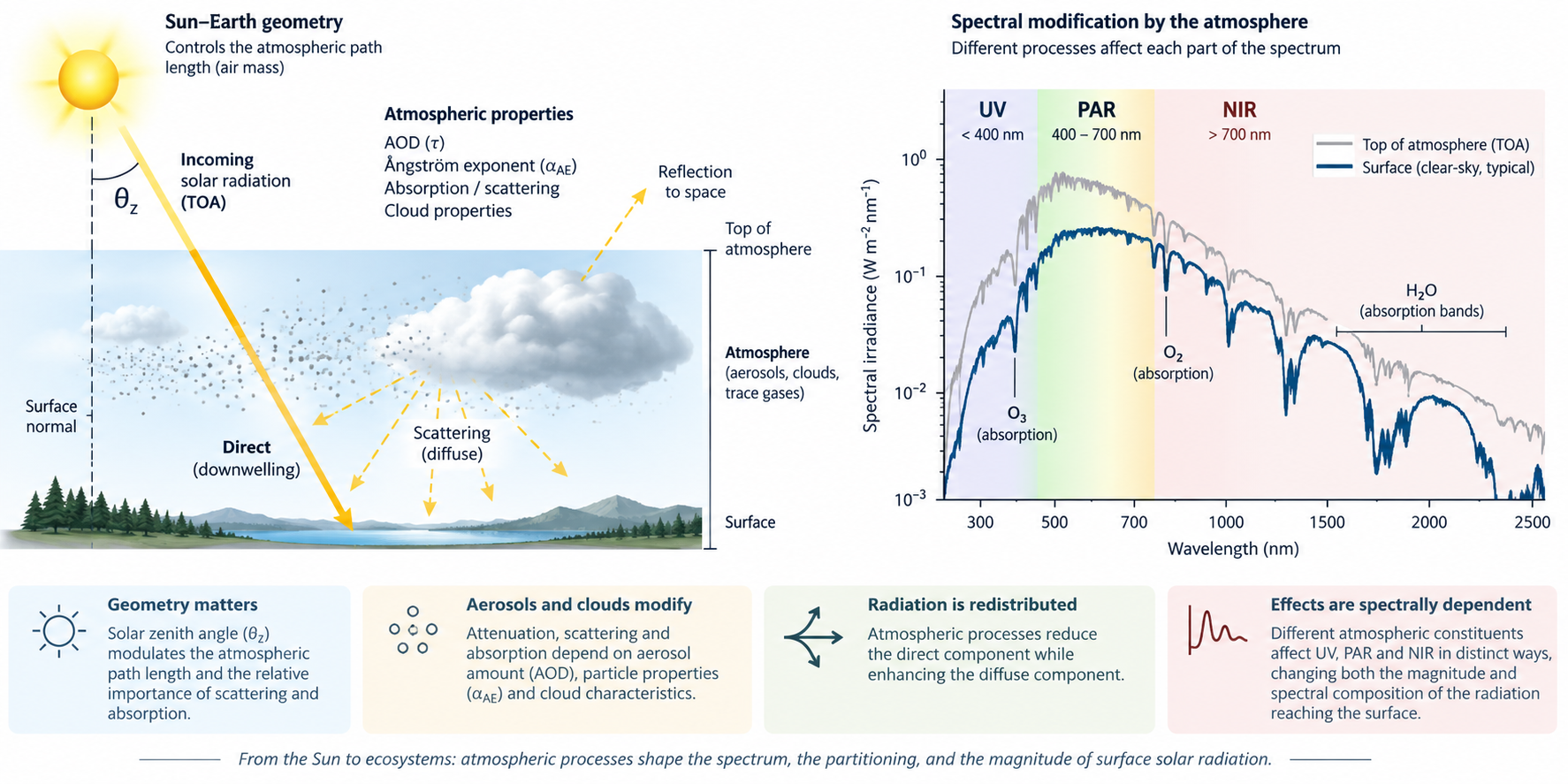
Radiative forcing depends on more than atmospheric loading
The magnitude and evolution of aerosol radiative effects cannot be interpreted from aerosol amount alone. Long-term analyses showed changes in aerosol forcing efficiency and, more recently, a strong dependence of erythemal-UV aerosol forcing on solar geometry and aerosol optical properties. In the UV, aerosol optical depth declined markedly without a corresponding surface brightening, while coarse and absorbing particles exerted an important control on forcing. Together, these findings show that atmospheric loading, particle properties, spectral range and Sun–Earth geometry must be considered jointly when interpreting radiative forcing.
The cloud analysis provides a complementary long-term result: at the analysed Mediterranean site, cloud radiative forcing evolved consistently with a weakening of the surface cooling effect of clouds over the study period, illustrating that atmospheric radiative effects need not remain stationary through time.
Further reading:
Lozano et al. (2021), Atmospheric Research 255, 105538
Lozano et al. (2023), Atmospheric Research 296, 107072
Lozano et al. (2026), Physics and Chemistry of the Earth 144, 104518
Aquatic ecosystem responses emerge from interacting environmental and trophic controls
Aquatic ecosystems respond to combinations of environmental and biological controls rather than to individual drivers in isolation. Work in Mediterranean and high-mountain aquatic systems showed that algal–bacterial relationships can shift over time alongside changes in temperature, nutrient stoichiometry and atmospheric inputs, while the strength and direction of phytoplankton–bacteria coupling can also depend on trophic-web interactions. Experimental work further showed that increased nutrient availability can expose responses to UV radiation or elevated CO₂ that are not apparent when those factors are considered independently.
The broader implication is that ecosystem responses to future environmental conditions cannot always be inferred by adding together responses measured for individual drivers; interactions among physical forcing, nutrient availability and biological processes can alter the resulting metabolic balance.
Further reading:
González-Olalla et al. (2018), Scientific Reports 8, 10278
Lozano et al. (2023), Microbial Ecology 86, 810–824
Lozano (2024), Marine and Freshwater Research 75(9), MF23137
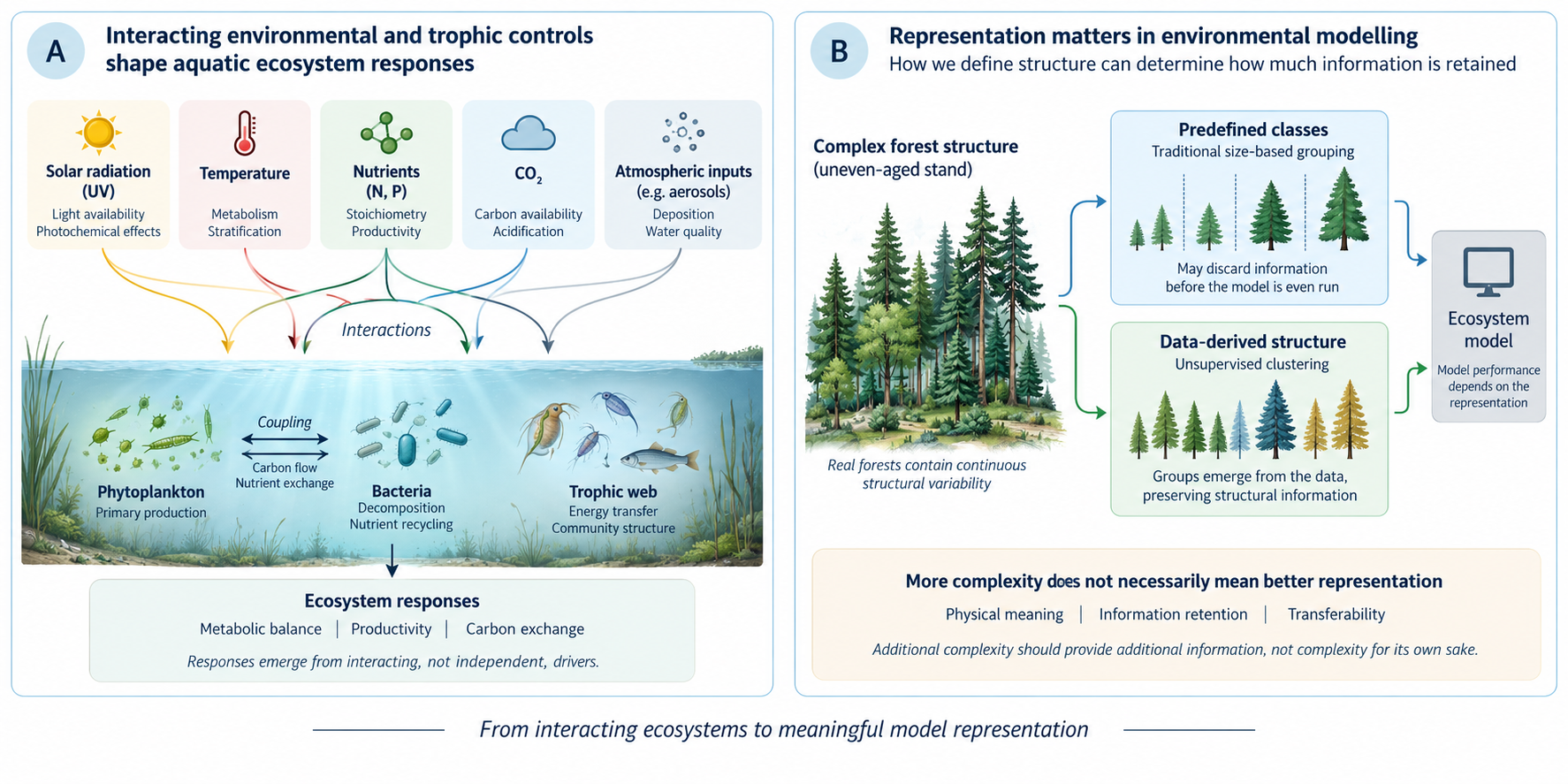
Complex forest structure can emerge from the data instead of being imposed beforehand
In uneven-aged forests, predefined size classes can discard structural information before an ecosystem model is even run. Comparing traditional classifications with unsupervised approaches showed that data-derived groupings generally represented key structural variables such as diameter, height and basal area more accurately. The result suggests that allowing groups to emerge from the multivariate structure of the stand can provide a more faithful representation than imposing fixed classes a priori.
More broadly, this shows that the way environmental complexity is represented can itself become an important source of model performance and uncertainty: improving representation does not necessarily require increasing the number of groups or the complexity of the underlying ecosystem model.
Further reading:
Physically informed simplicity can compete with more complex models
Greater model complexity does not automatically produce a better environmental representation. Across different radiation problems, relatively simple formulations built around physically meaningful predictors have achieved performance comparable to, and in some cases better than, approaches requiring additional variables or greater statistical flexibility. In diffuse PAR estimation, physically motivated relationships were able to reproduce much of the observed variability despite comparison with highly flexible machine-learning approaches; related work showed that aerosol forcing on PAR can be estimated from widely available global irradiance and solar geometry.
The same principle emerged independently in net-radiation modelling: adding further predictors did not necessarily improve performance, and the simplest formulations remained competitive across contrasting sites and conditions. The broader lesson is not that models should always be simple, but that additional complexity should provide additional physical information rather than complexity for its own sake.
Further reading:
Foyo-Moreno et al. (2023), Atmospheric Research 291, 106819
Lozano et al. (2023), Journal of Geophysical Research: Atmospheres 128, e2023JD039256
Conferences & talks
Selected oral presentations and posters presented at international conferences across atmospheric radiation, ecosystem science, forest modelling, and environmental research.
A TOA-consistent transmissivity-based mapping of global and diffuse PAR from broadband shortwave radiation
Oral presentation
López Lozano, I.; Ezhova, E.; Foyo Moreno, I.; Alados Arboledas, I.; Kulmala, M.
EMS Annual Meeting 2026, 6–11 September 2026, Utrecht, Netherlands. EMS2026-320.
DOI: 10.5194/ems2026-320
Highlight: First conference presentation of the transmissivity-based spectral-closure framework, introducing its application to the reconstruction of global and diffuse PAR from broadband shortwave radiation.
Enhancing Forest Structure Estimations through Unsupervised Clustering Methods
Oral presentation
Lozano, I.; Minunno, F.; Mäkelä, A.
SSAFR 2024 — 20th Symposium on Systems Analysis in Forest Resources, 13–17 May 2024, Hondarribia, Spain.
Highlight: Presented the use of unsupervised clustering to derive tree groups directly from stand structure, showing an alternative to predefined size classifications for representing uneven-aged forests.
ESA Forest Carbon Monitoring project – Key achievements
Poster
Miettinen, J.; Antropov, O.; Auvinen, M.; Cartus, O.; Herold, M.; Häme, L.; Häme, T.; Katila, M.; Korhonen, K. T.; Lozano, I. L.; et al.
11th International Workshop on Science and Applications of SAR Polarimetry and Polarimetric Interferometry — PolInSAR & Biomass, 19 June 2023, France.
Effect of forest management choices on carbon sequestration and biodiversity at national scale – a simulation study
Oral presentation
Mäkelä, A.; Minunno, F.; Junttila, V.; Lozano, I.; Forsius, M.
Cross-sectoral ISIMIP–PROCLIAS Workshop 2023, Inter-Sectoral Impact Model Intercomparison Project, 6 June 2023, Prague, Czech Republic.
Analysing the aerosol radiative effects at Granada during 2008–2018
Poster
Lozano, I. L.; Sánchez-Hernández, G.; Guerrero-Rascado, J. L.; Alados, I.; Foyo-Moreno, I.
11th International Aerosol Conference (IAC2022), 4 September 2022, Athens, Greece.
Dealing with the vertical dimension of extreme pollution episodes
Oral presentation
Alados-Arboledas, L.; Abril-Gago, J.; Bermejo-Pantaleón, D.; Bravo-Aranda, J. A.; Casans-Gabasa, A.; Casquero-Vera, J. A.; Castillo, S.; Cazorla, A.; Foyo-Moreno, I.; Granados-Muñoz, M. J.; Guerrero-Rascado, J. L.; Jiménez-Martín, M. M.; Lozano, I.; Lyamani, H.; Navas-Guzmán, F.; Olmo, F. J.; Pérez-Ramírez, D.; Rejano, F.; Sánchez-Hernández, G.; Titos, G.; Valenzuela, A.
European Lidar Conference 2021 (ELC2021), 16–18 November 2021, Granada, Spain.
A preliminary analysis to evaluate the effects of aerosols on photosynthetically active radiation at Granada
Poster
Lozano, I. L.; Foyo-Moreno, I.; Alados, I.; Alados-Arboledas, L.
7th Iberian Meeting on Aerosol Science and Technology, 9–11 July 2019, Lisbon, Portugal.
Phytoplankton–bacteria coupling: New insights on a renewed topic
Oral presentation
Lozano, I. L.; González-Olalla, J. M.; Cabrerizo, M. J.; Villar-Argaiz, M.; Carrillo, P.; Medina-Sánchez, J. M.
X Symposium for European Freshwater Sciences, 2–7 July 2017, Olomouc, Czech Republic.
Highlight: Presented early work showing that phytoplankton–bacteria coupling should be interpreted within the wider trophic web rather than as an isolated two-component interaction, anticipating a research line later developed in the published microbial-ecology work.
Microbial biomanipulation based on labile carbon enrichment as a low-cost tool for eutrophication control in Mediterranean inland waters
Poster
Medina-Sánchez, J. M.; Dorado-García, I.; Sarañana-Alonso, A. A.; Lozano, I. L.; Carrillo, P.
BIOREMID 2017 — International Meeting on New Strategies in Bioremediation Processes, 9-10 March 2017, Granada, Spain.
Has mixotrophic metabolism been altered by climate-driven changes after a decade?
Oral presentation
González-Olalla, J. M.; Medina-Sánchez, J. M.; Lozano, I. L.; Villar-Argaiz, M.; Carrillo, P.
International Society of Limnology Congress, 31 July–5 August 2016, Turin, Italy.
Continue exploring