My research focuses on how solar radiation and atmospheric processes interact with ecosystems, shaping climate feedbacks, carbon cycling, and environmental change across terrestrial and aquatic systems.
Rather than addressing isolated drivers, my work examines how radiative processes, aerosols, clouds, and climate variability are coupled with biosphere responses, and how these interactions influence both short-term variability and long-term trends.
These themes reflect questions that matter to climate science, environmental decision-making, and ecosystem resilience under global change, connecting atmospheric physics to real-world impacts.
The research themes below represent the core scientific questions connecting my work across atmospheric physics, remote sensing, limnology, and ecosystem science, while maintaining a consistent focus on atmospheric drivers and physical mechanisms.
Solar Radiation as a Climate–Ecosystem Driver
Solar radiation is the primary energy input to the Earth system, but its ecological relevance depends not only on magnitude, but also on spectral composition and partitioning between direct and diffuse components. A central theme of my research is understanding how variations in photosynthetically active radiation (PAR) and broadband shortwave radiation regulate ecosystem productivity and carbon uptake.
My work demonstrates that clouds and atmospheric conditions can substantially modify the quantity and quality of radiation available for photosynthesis, with diffuse radiation often enhancing ecosystem efficiency despite reductions in total irradiance. By analysing long-term observational datasets, I have identified how these effects vary seasonally and interannually, highlighting limitations in simplified radiation metrics commonly used in climate and ecosystem studies.
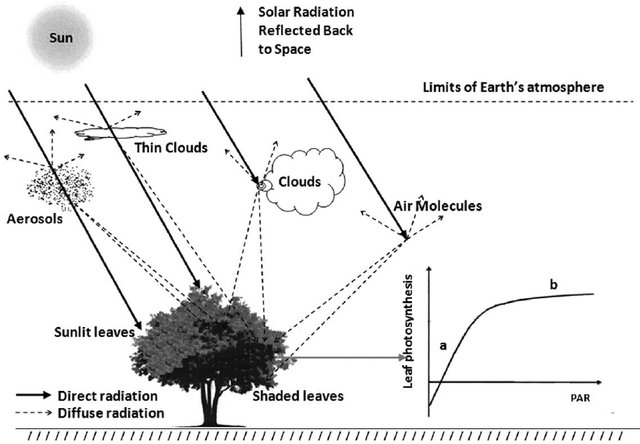
image source: https://doi.org/10.1177/0309133311434244
Aerosol and Cloud Radiative Effects Across Spectral Ranges
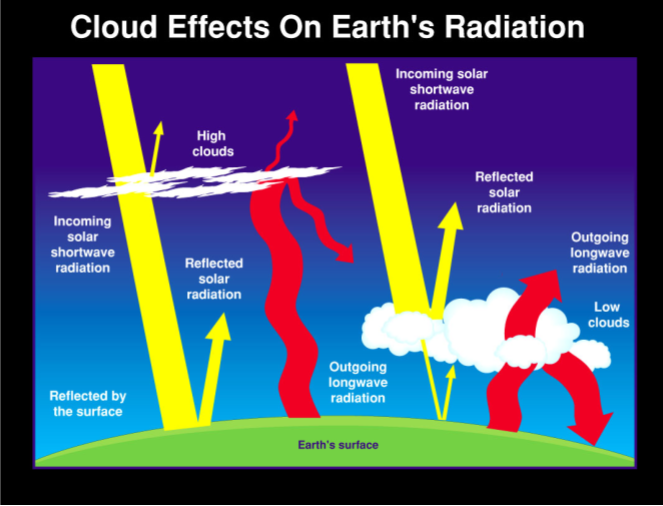
image source: https://mynasadata.larc.nasa.gov/sites/default/files/inline-images/cloudseffectsonearthsradiation_1.png
Atmospheric aerosols and clouds exert a strong influence on surface radiation, yet their effects are often treated uniformly across wavelengths. A major focus of my work is quantifying how aerosol and cloud radiative effects differ between spectral ranges, particularly between photosynthetically active radiation and total shortwave irradiance.
Through long-term analyses of aerosol radiative forcing and forcing efficiency, my research shows that PAR can be more sensitive to atmospheric perturbations than total radiation, with important implications for trend attribution, climate interpretation, and ecosystem impact assessments. This work highlights that neglecting spectral dependence can introduce systematic biases in both atmospheric and biospheric analyses.
Understanding how spectral radiation is altered by aerosols and clouds naturally leads to asking how these altered radiation fields then affect biological systems, which is the focus of the next theme.
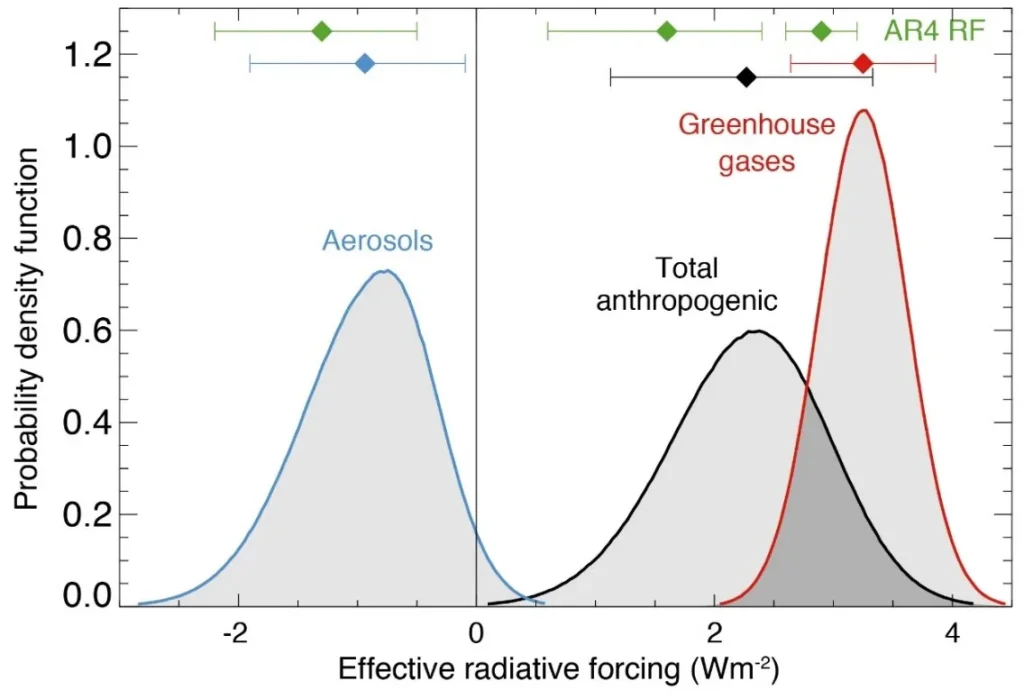
source: IPCC AR5
Atmosphere–Biosphere Feedbacks Mediated by Radiation
Radiative changes induced by aerosols, clouds, and climate variability propagate beyond the atmosphere and into ecosystems, generating feedbacks that influence carbon cycling and climate dynamics. A key theme of my research is understanding how radiation-mediated processes link atmospheric change to biological responses across different biosphere components.
While rooted in atmospheric physics, this theme integrates structural understanding of ecosystems (from forest canopies to aquatic columns) to address how physical forcing translates into biological response.
Within this framework, I have worked on both aquatic and terrestrial systems, including forests as structurally complex, radiation-regulated ecosystems. Accurate representation of ecosystem structure is essential for quantifying radiation transfer, productivity, and feedback strength. In this context, my recent work integrates atmospheric and climate expertise within a forest modelling environment, including the use of data-driven approaches to improve forest structure estimation in uneven-aged stands. This contributes to a more realistic coupling between atmospheric forcing, radiation regimes, and biosphere responses.
Climate Change Drivers Modulating Biosphere Responses
Ecosystem responses to climate change are driven by the combined influence of multiple atmospheric and environmental drivers, including solar radiation, temperature, CO₂, nutrient availability, and ultraviolet radiation. A central theme of my research is diagnosing how these drivers jointly modulate biosphere responses, with a particular focus on aquatic ecosystems.
Focusing on aquatic systems as a primary example, this theme examines how multiple atmospheric drivers combine to shape ecosystem trajectories under global change.
Using long-term observations and innovative experimental designs, my work shows that ecosystem responses are often non-linear and interaction-driven, rather than controlled by single factors. Changes in atmospheric forcing can alter metabolic balance, trophic coupling, and CO₂ exchange, leading to shifts between heterotrophic and autotrophic states. While much of this work is grounded in aquatic systems, similar multi-driver challenges arise in terrestrial environments such as forests, where climate forcing, radiation regimes, and structure jointly shape biosphere responses.
Concluding perspective
Together, these research themes contribute to a unified understanding of how atmospheric processes, radiation, and climate drivers interact with ecosystems, shaping feedbacks relevant to the carbon cycle and environmental change. By combining long-term observations, physical interpretation, and ecosystem-level analysis, my work aims to improve both scientific understanding and the relevance of atmospheric science for environmental assessment and decision-making.